
What Does a Radon Test Result Really Mean? Introducing Radon Visualizer
· By Deise (Daisy) Rezende | Smart Home Inspects
Imagine receiving a radon test report showing a concentration of 4.0 picocuries per liter (pCi/L).
What does that number actually mean?
You might know that 4.0 pCi/L is the level at which the Environmental Protection Agency recommends taking action to reduce radon in a home. But can you picture what that concentration represents?
How many radon atoms are in the air? How many travel through your lungs as you breathe? And what happens when those radioactive atoms decay?
These questions inspired the creation of Radon Visualizer, a free interactive educational website developed by Deise (Daisy) Rezende, co-owner of Smart Home Inspects and Smart Home Radon.
Explore Radon Visualizer at RadonVisualizer.com (opens in a new tab)
Making an Invisible Gas Easier to Understand
Radon is a naturally occurring radioactive gas produced through the decay of uranium in soil and rock.
It has no color, odor, or taste, which means a home can have elevated radon concentrations without any obvious signs.
Radon testing provides a measurement of its concentration in indoor air. But understanding the number on a report is another matter.
Radon Visualizer was created to bridge that gap.
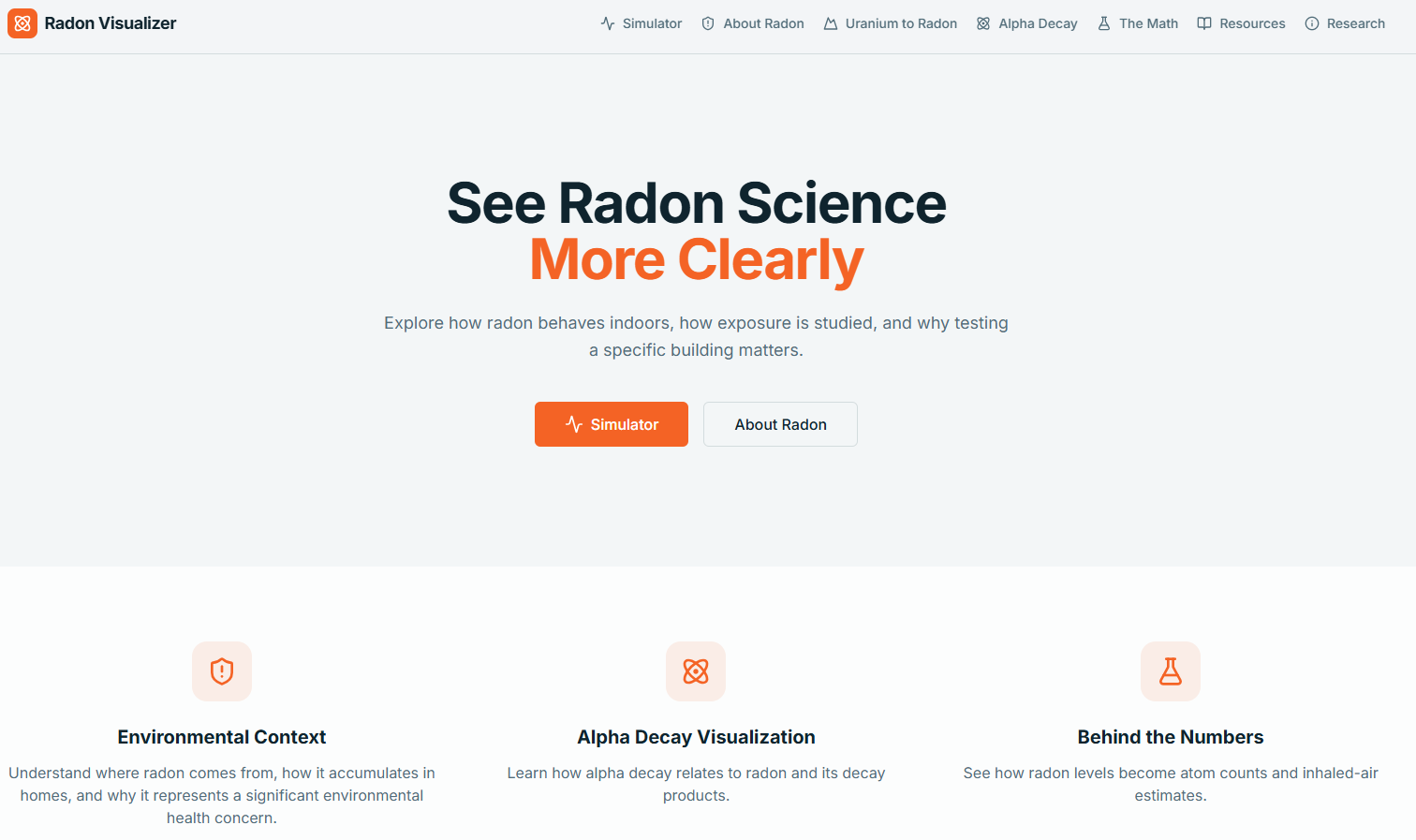
The website turns radon concentrations into interactive calculations and illustrations, helping visitors explore the science behind the numbers.
What Can You Explore?
The interactive simulator allows visitors to enter a radon concentration, select an age group and activity level, and explore different time periods.
As the settings change, the simulator calculates:
- The estimated number of radon atoms present in each liter of air.
- The number of atoms carried in inhaled air based on an assumed breathing rate.
- How cumulative inhaled-air estimates change with time spent in a room.
An animated illustration shows radon gas moving through the airways, along with a conceptual representation of radioactive decay products and alpha radiation.
For visitors interested in learning more, the website also includes educational explanations of radon's origins, radioactive decay, the mathematics behind the calculations, and a library of published scientific research.
A short guided audio tour introduces the simulator and helps visitors get started.
Why Understanding Radon Matters When Buying a Home
During a real estate transaction, buyers often have limited time to review inspection findings, evaluate environmental concerns, and make important decisions.
A radon result can become just another number on a long list of inspection findings.
But radon deserves to be understood.
The EPA identifies radon as the leading cause of lung cancer among people who do not smoke. Long-term exposure to elevated indoor radon concentrations increases lung cancer risk.
Testing is how we determine the radon concentration in a particular home.
Radon Visualizer provides a different kind of information. It helps explain the scientific concepts behind that measurement.
The two complement each other: testing tells you what was measured, while education helps you understand what the result represents.
From Measurement to Understanding
At Smart Home Inspects, we believe that good inspection services should do more than deliver reports.
Homeowners deserve to understand the information they're receiving.
That philosophy helped inspire Radon Visualizer.
Whether you're buying a home, reviewing a previous radon test, or simply curious about radioactive decay, the website offers an opportunity to explore radon science in an accessible, interactive format.
Visit RadonVisualizer.com and explore the science behind every breath. (opens in a new tab)
Professional Radon Testing in Maryland
Radon Visualizer is an educational resource, not a device for measuring the radon concentration in your home.
To determine the indoor radon concentration of a specific property, testing is necessary.
Smart Home Inspects provides professional residential and real estate radon testing throughout our Maryland service area, helping buyers, sellers, and homeowners obtain documented measurements and understand their results.
Learn more about professional radon testing with Smart Home Inspects.
About the Author
Deise (Daisy) Rezende is the co-owner of Smart Home Inspects and Smart Home Radon, an NRPP-certified Radon Measurement Professional, and the developer of Radon Visualizer. Her work combines field measurement, environmental education, and a commitment to making technical information easier for the public to understand.